 Fossil Identifier
FIELD GUIDE
Crinoid fossil identification
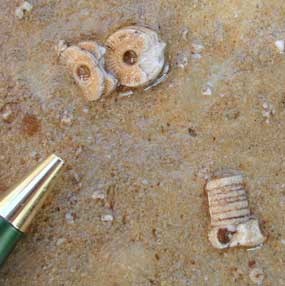
Small ring-like discs or stacks of segments can be crinoid stem fragments. Crinoids are animals related to other echinoderms, despite their plant-like “sea lily” nickname.
Features to compare
| Feature | What to look for | What it cannot prove |
|---|---|---|
| Single disc | Possible separated stem segment | Inspect both flat faces. |
| Stack of discs | Possible connected stem | Check repeating joints along the length. |
| Center opening | Round or patterned canal | Its shape alone rarely identifies a species. |
| Many fragments in rock | Possible crinoid-rich material | Compare several pieces before choosing a match. |
Start by comparing several segments
A single circular stone can be ambiguous. If the rock contains more than one disc, look for consistent size ranges, central openings, and repeated joint surfaces. A side view of a connected stack can be more useful than one face-on image.
Avoid the “tiny screw” trap
A broken stem can resemble a manufactured object because its segments repeat. Photograph the surface and the surrounding rock, then compare a reference specimen. Do not assume a precise species from a hole shape or a small fragment.
Photograph without extracting
Take a wide shot that includes the host rock, a close view of the discs, and a side view where available. Include scale and locality. Leaving a delicate specimen in its matrix can preserve the relationships that make it understandable.
Questions collectors ask
Are crinoids plants?
No. Their sea-lily appearance is misleading; they are marine animals.
Can the app identify an isolated disc?
It can suggest a group, but a worn disc may not preserve enough detail for a confident identification.
References & further reading
Prepared with AI assistance and linked public educational references. No specialist review is claimed.