 Fossil Identifier
FIELD GUIDE
Petrified wood identification
Petrified wood preserves evidence of wood in mineral material. Look for connected wood-like structures, not just a brown surface or stripes in a stone.
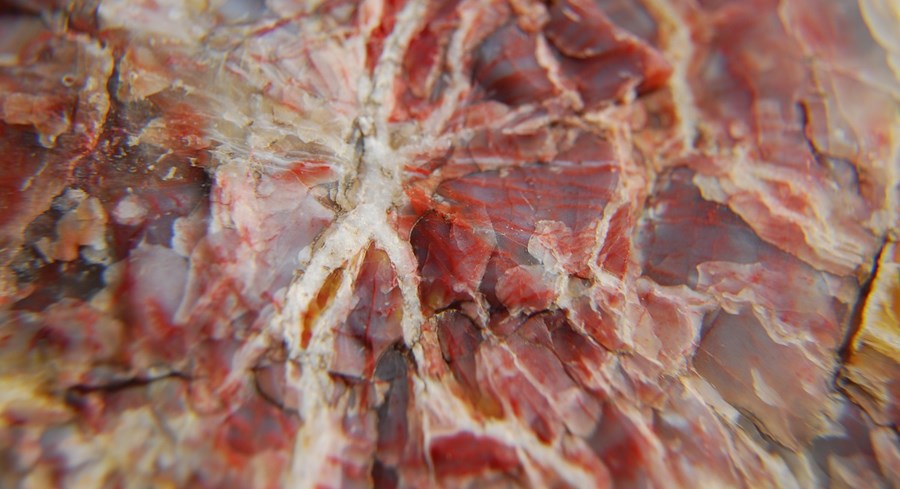
Features to compare
| Feature | What to look for | What it cannot prove |
|---|---|---|
| Grain-like lines | Possible preserved wood structure | Compare the side and end surfaces. |
| Rings on an end face | Possible growth pattern | Mineral bands can imitate rings. |
| Crystalline surface | Mineral material | Sparkle alone does not establish a wood origin. |
| Log-like shape | Useful context | A rounded stone is not enough. |
Read the side and end together
A specimen may look convincing from one direction and ambiguous from another. Photograph a long surface to show grain-like detail and an existing end or broken face to show cross-sectional patterns. Do not cut the specimen just to create a diagnostic view.
Color is secondary evidence
Minerals can give petrified wood a wide range of colors. The National Park Service describes quartz-rich petrified wood at Petrified Forest, but a colorful or quartz-like stone is not automatically wood. Focus on the preserved structures.
Record uncertainty in the collection
Save a likely identification with the photos and locality. If the visible grain does not continue between surfaces, note that mismatch. A local geology group may help distinguish preserved tissue from mineral banding without destructive tests.
Questions collectors ask
Is petrified wood still ordinary wood?
Its preserved structure is associated with mineral material. It is not the same as a piece of recent dried wood.
Can I collect it in a national park?
Check the rules for the specific site. Do not remove specimens where collection is prohibited.
References & further reading
Prepared with AI assistance and linked public educational references. No specialist review is claimed.