 Fossil Identifier
FIELD GUIDE
Shark tooth identification
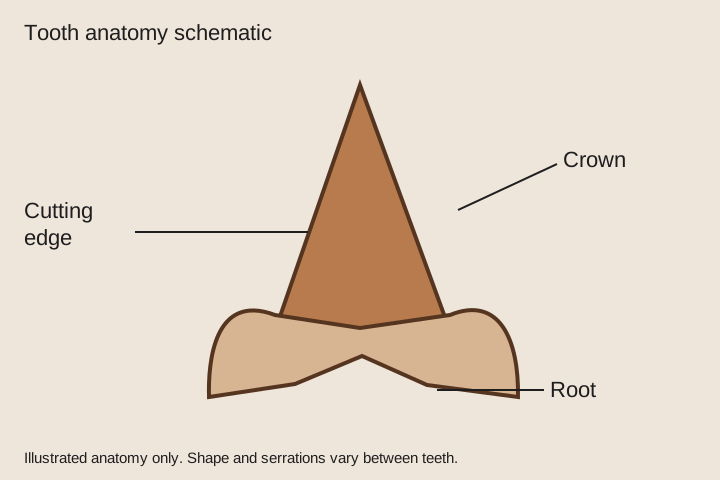
Before naming a shark, establish whether the object is a tooth. Photograph the crown, root, cutting edges, and both faces. A chipped triangular stone can imitate the silhouette without preserving tooth structure.
Features to compare
| Feature | What to look for | What it cannot prove |
|---|---|---|
| Crown | Pointed or blade-like part | Record the shape, including any curve. |
| Root | Broader base below the crown | A broken root removes useful evidence. |
| Edges | Smooth or serrated | Wear can erase small serrations. |
| Color | Variable mineral staining | Black does not identify a species or establish a precise age. |
Why one shark can have different tooth shapes
Tooth form can vary with its position in the jaw. Compare several features together rather than relying on one image match. The Florida Museum provides detailed tooth references that can help you evaluate a provisional app result.
Do not call every large tooth megalodon
A large triangular crown is an interesting clue, not a complete diagnosis. Record dimensions and photograph the crown-root boundary clearly. If the root or edges are missing, keep the identification broad rather than forcing a species name.
How to photograph a small tooth
Place it on a plain background beside a ruler. Use diffuse daylight, tap to focus, and keep the whole tooth sharp. Photograph front, back, and edge views. Record the find location separately; the locality can help with geological context.
Questions collectors ask
Are black shark teeth always fossils?
Color can be affected by mineral staining. Use the specimen’s structure and geological context rather than color alone.
Can a photograph tell me the value?
An app estimate is a starting point, not authentication or a sale price. Condition, identity, provenance, and the market all matter.
References & further reading
Prepared with AI assistance and linked public educational references. No specialist review is claimed.