 Fossil Identifier
FIELD GUIDE
Trilobite identification
Look for a segmented body with a central axis and matching side regions. The name “trilobite” refers to these three lengthwise divisions, not simply a head, middle, and tail.
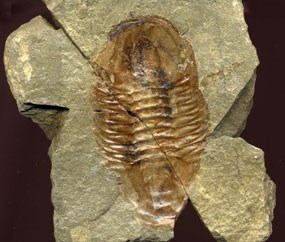
Features to compare
| Feature | What to look for | What it cannot prove |
|---|---|---|
| Central axis | Raised middle running lengthwise | Check whether side regions align with it. |
| Segments | Repeated body plates | A shell can also have ribs; examine the complete pattern. |
| Head shield | Broader front region | It may be detached or incomplete. |
| Rolled shape | Curled body | Look for the segmented structure rather than a rounded lump alone. |
Complete body, fragment, or shed shell?
A fossil need not preserve a complete animal. A detached shield or a small patch of segments may only support a broad identification. Trilobites shed their exoskeletons as they grew, so fossil material can represent a molt.
Compare it with a ribbed shell
Shell ribs can look like body segments in a cropped photograph. Include the full outline and side profile. Ask whether the repeating elements continue around a central axis or radiate outward over a shell-shaped surface.
What to save with the app result
Keep a face-on photo, an oblique view, a scale reference, and the find location. Note which features are genuinely visible and which are inferred. A clear identification at group level is useful even when a species name remains uncertain.
Questions collectors ask
Does a trilobite need to be flat?
No. Some specimens preserve a rolled posture, and many finds are incomplete.
Can shell fragments look like trilobites?
Yes. Repeating ribs can be misleading in isolation. Compare the outline, central axis, and segment arrangement.
References & further reading
Prepared with AI assistance and linked public educational references. No specialist review is claimed.